
Spring according to Van Gogh
The season in 6 paintings, plus all the art news you need to know

we’ve turned on 7-day free trials

Hi all, happy Monday!
Last week we wrote about Tate’s upcoming Monet show and the way in which his Giverny paintings have become so engrained in culture that they now turn up everywhere, from designer catwalks to shampoo bottles. If you want to read the full post or anything else from our paid archive, we’ve turned on 7-day free trials.

Moving from an Impressionist master to a Post-Impressionist one, today we’re celebrating Vincent van Gogh’s birthday.
Born on March 30, 1853, in Zundert, Netherlands, Van Gogh spent his early years trying to find his path. He had jobs as a clergyman, teacher, art dealer and evangelist, none of which worked out. By his late twenties, frustrated and still searching, he made the decision to become an artist. He was 30 when he began painting consistently.
After a brief stint at art school, he moved to Paris in 1886 to live with his brother Theo, and it was there that he encountered the Impressionists, forcing him to rethink the dark palette of traditional Dutch paintings and move towards a brighter use of colour. What followed was a period of intense output and rapid evolution.
In 1888 he left Paris for Arles. His mental health became increasingly unstable when he started suffering psychotic episodes linked to epilepsy, and it was during one of these crises that he cut off his left ear. He admitted himself to the asylum at Saint-Paul-de-Mausole in Saint-Rémy-de-Provence in 1889, where he continued to paint through periods of instability.
In May 1890 he left for Auvers-sur-Oise. That July, he shot himself in the chest and died two days later.
For such a brief and intense career, his optimism feels most visible in his spring paintings. Painted in the period around his birthday, they carry a sense of renewal, capturing the quiet reset of another year as much as the restorative rhythm of the season.
As he once explained in a letter to his sister Wilhelmina:
I have observed too often that neither my work nor my health is in very good condition during the winter.
Fishing in Spring, the Pont de Clichy (Asnières) (1887)
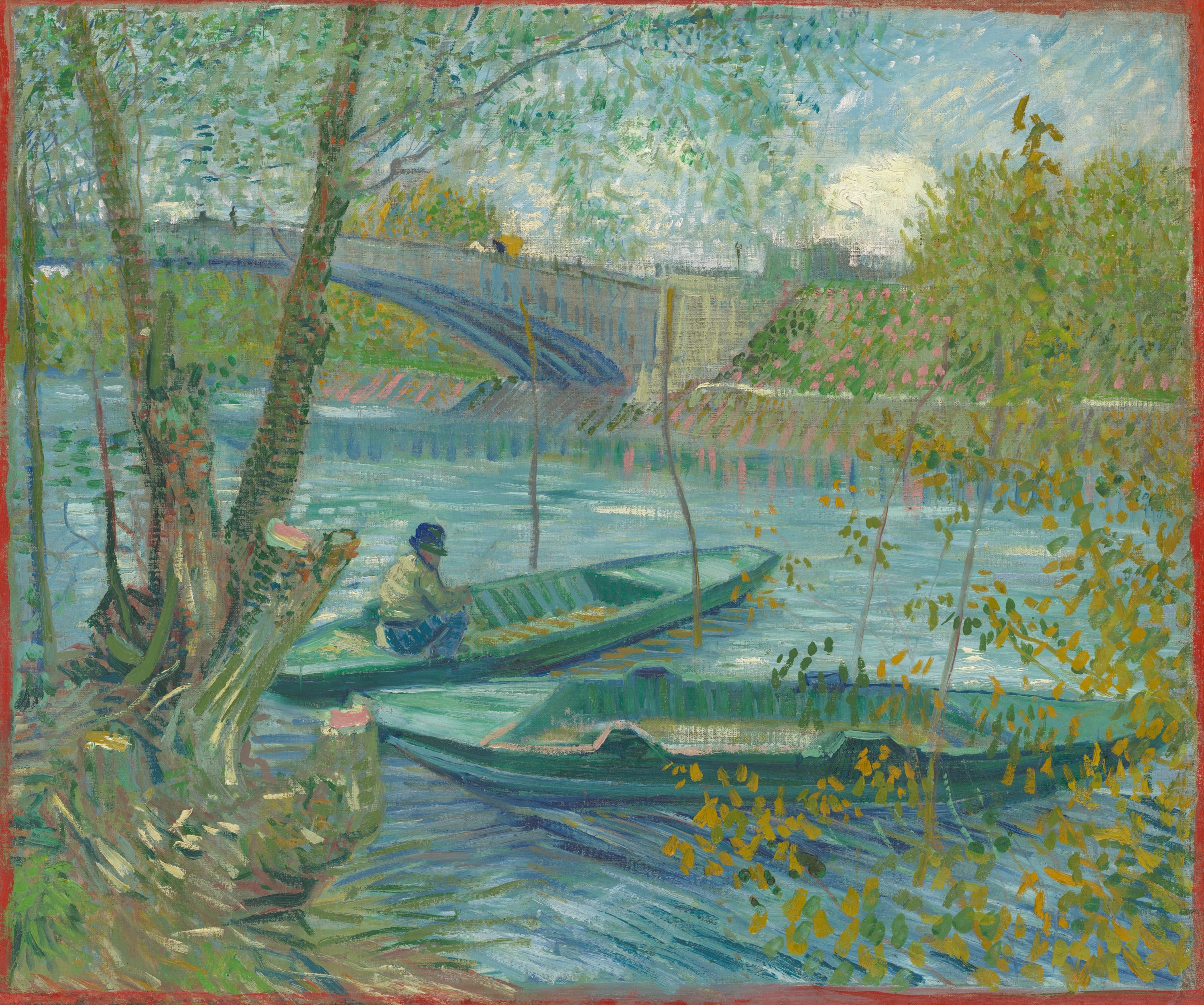
Painted during his two-year period in Paris, this work captures the movement of spring on the river Seine. The view centres on the Clichy Bridge near Asnières, which was set just outside Paris and was once a green escape for city dwellers. By the late 19th century, industry had moved in, and new bridges and rail lines opened it up, drawing artists keen to capture a landscape in transition. Van Gogh painted here on several occasions with fellow artist Paul Signac. You can feel Signac’s influence in Van Gogh’s use of small and vibrant brushstrokes that come together to give the sense of light reflecting off the boat, the river, the trees. This painting is now in the collection of the Art Institute of Chicago.
Pink Peach Trees (Souvenir de Mauve) (1888)
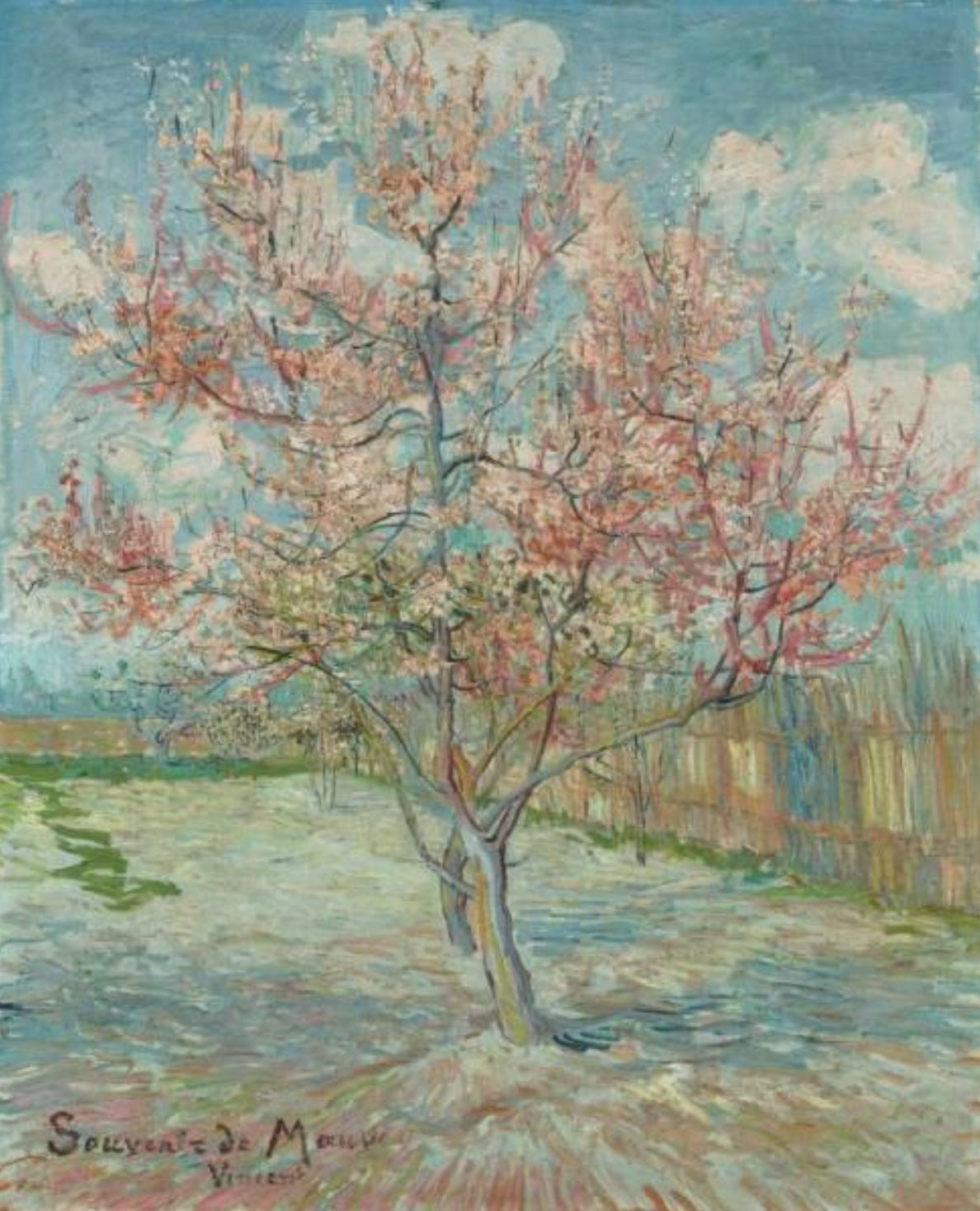
Painted in spring 1888, in the first weeks after Van Gogh arrived in Arles, Pink Peach Trees (Souvenir de Mauve) is one of 14 orchard scenes he produced between March 24 and April 21. Made outdoors, it captures the soft bloom of a peach tree set against an open, lightly worked landscape—a study in air, colour, and the first signs of the season turning. On the day he painted it, Van Gogh learned of the death of his cousin and early mentor Anton Mauve. You can see in bold text how Van Gogh dedicated the canvas to Mauve, and the piece was later sent to Mauve’s widow as a gesture of condolence. The work is now in the collection of the Kröller-Müller Museum, Netherlands.
It was in the same year this work was painted that Van Gogh started experiencing psychotic episodes, and he cut off his ear.
Orchard in Blossom (1889)
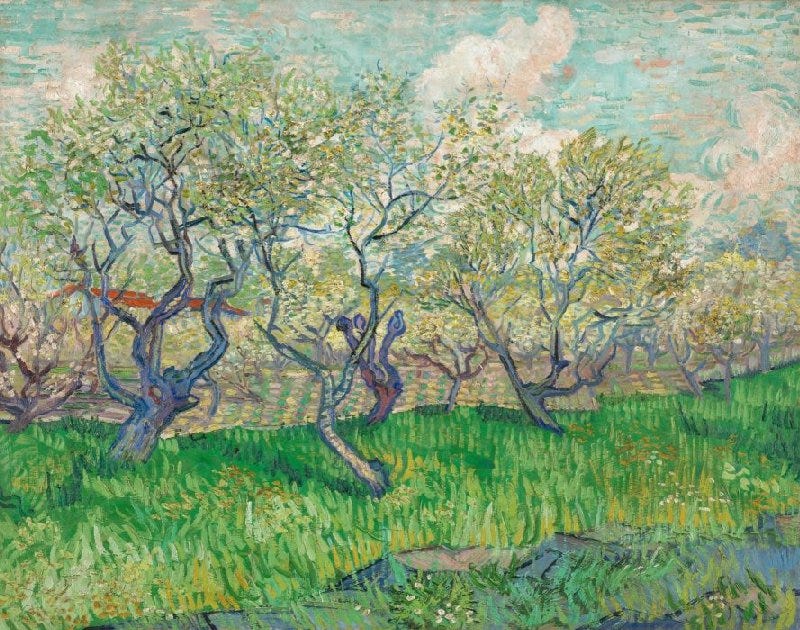
In 1889, Van Gogh admitted himself to the asylum at Saint-Paul-de-Mausole in Saint-Rémy-de-Provence. Among the works he brought with him was Orchard in Blossom, which he began during his prolific period of painting the orchards back in Arles. This canvas focuses on plum trees rather than the peach, almond, and apricot varieties that appear elsewhere in the group. Unsatisfied with the original result, he continued to work on it, reworking the tones and ultimately completing it purely from memory. It is now in the collection of the Van Gogh Museum, Amsterdam.
Almond Blossom (1890)
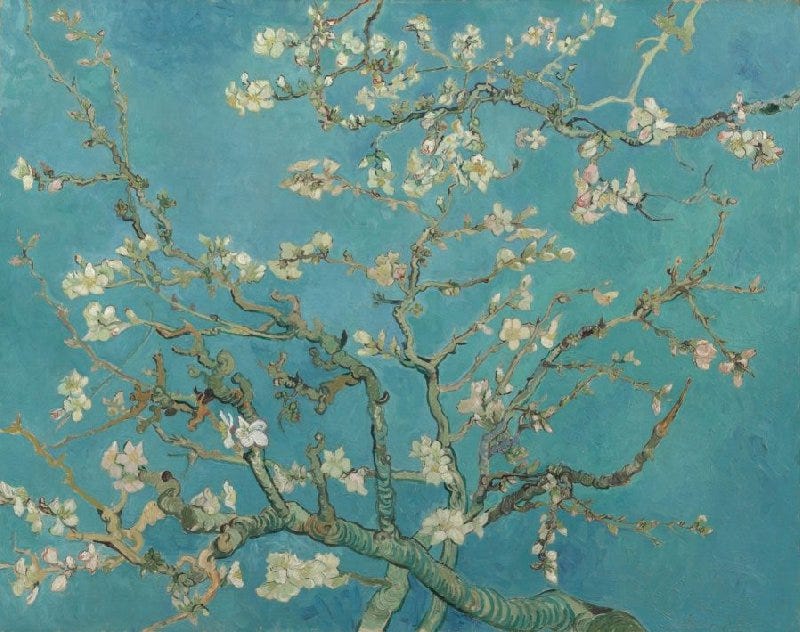
Perhaps the most well-known and purest expression of spring Van Gogh ever painted, Almond Blossom, was made as a gift for his brother Theo’s and sister-in-law Johanna’s newborn son. Almond trees flower early in the spring, making them a symbol of new life. Thus, this close crop of branches across a clear blue sky, inspired by Japanese prints, was the perfect way to welcome his new family member.
In a letter announcing the baby’s arrival, his brother wrote:
As we told you, we’ll name him after you, and I’m making the wish that he may be as determined and as courageous as you.
This work is in the collection of the Van Gogh Museum, Amsterdam.
Roses (1890)
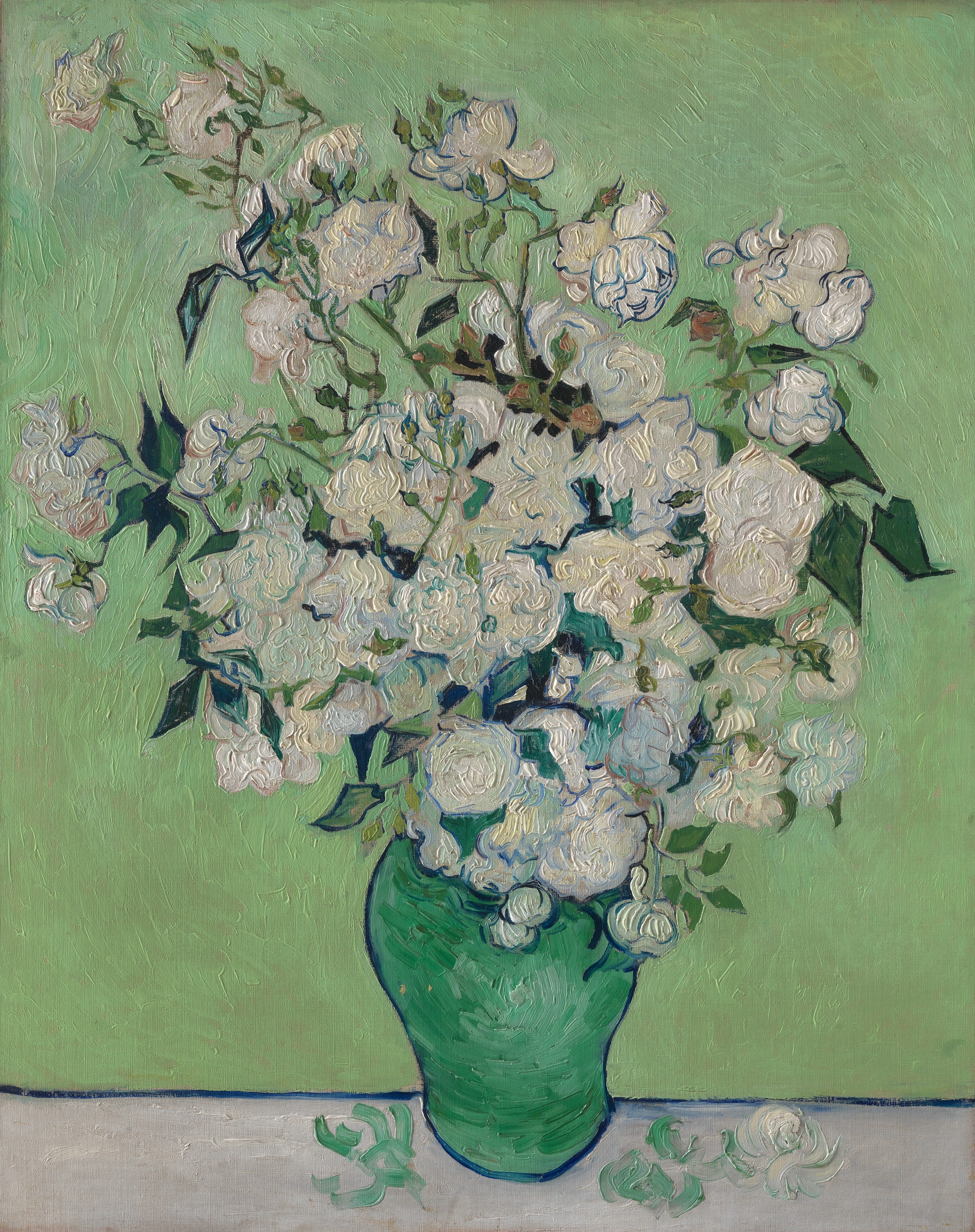
Just before Van Gogh checked himself out of his year-long stay at the asylum, he painted a series of 4 floral still lifes, of which Roses was one. While his brushwork and use of colour are more uniform here, there is still an enormous sense of movement within the composition, evident in textured strokes and the way petals have fallen down onto the tabletop. This work is held at the Metropolitan Museum of Art, alongside another one of the still lifes, Irises (1890). Both paintings were owned by Van Gogh’s mother until her death in 1907.
Roses in particular has a long and storied provenance. It left the Van Gogh family in 1908, sold by Johanna van Gogh-Bonger to major Berlin collections including Cassirer and then Franz and Margarete Oppenheim. In the 1930s it was sold from the Oppenheim estate to Georg Simon Hirschland before he was forced to emigrate during the Nazi era, at which point the painting entered the possession of the Folkwang Museum, Essen, Germany. The painting was later restituted to Hirschland’s heirs in 1950. It then moved into the American market, sold through Wildenstein to health activist and philanthropist Mary Lasker in 1951. By 1979 it was purchased by Walter and Leonore Annenberg, remaining in their collection for decades until it was gifted by bequest to the Metropolitan Museum of Art in 2002.
The remaining two works in the series, also titled Irises and Roses, are in the collection of the Van Gogh Museum, Amsterdam, and the National Gallery of Art, Washington, D.C., respectively.
Green Wheat Fields, Auvers (1890)
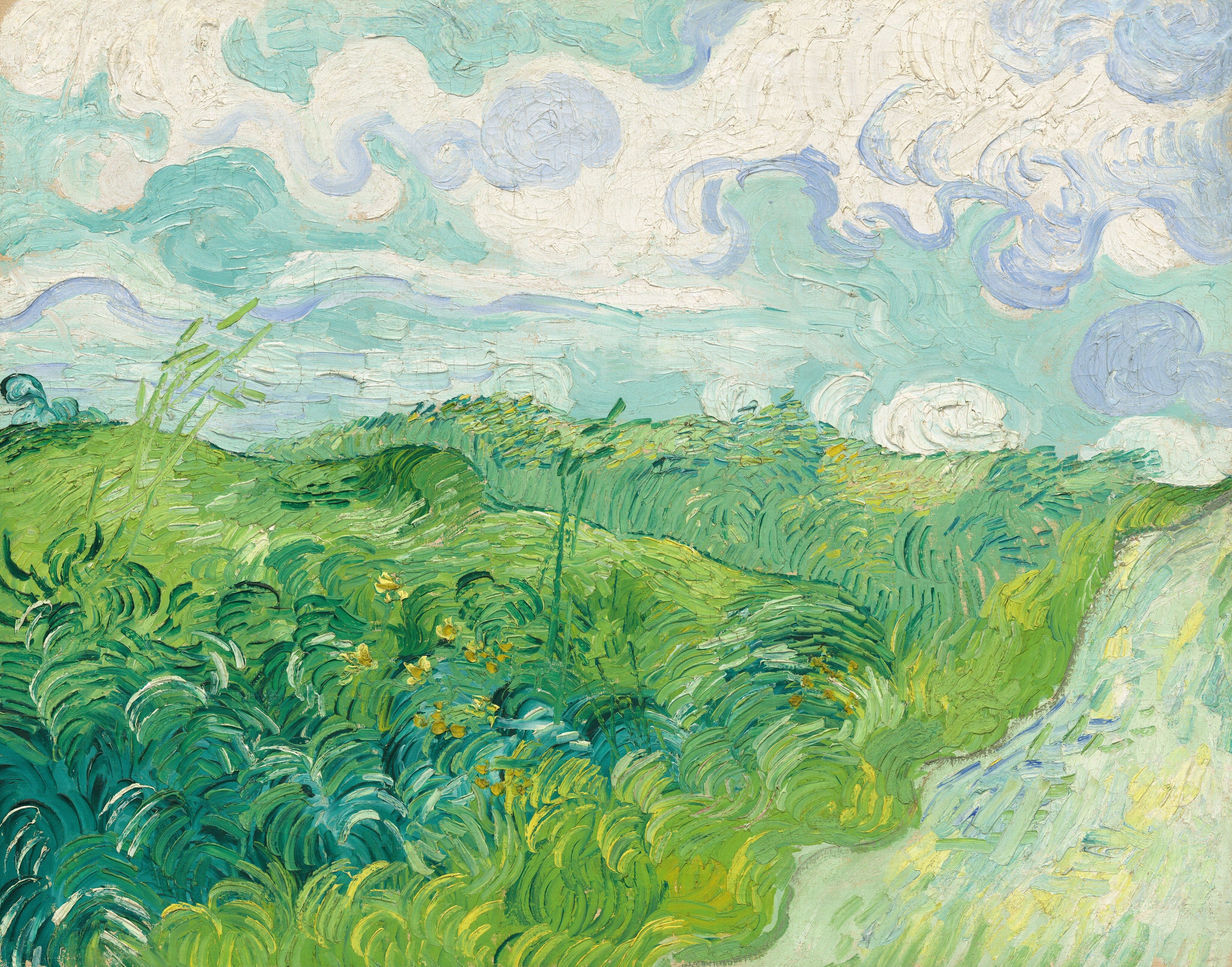
After leaving the asylum, Van Gogh travelled north, this time settling in the rural town of Auvers-sur-Oise, outside Paris. This painting was made during the last months of his life and harnesses cooler tones in contrast to the warm, hot hues possessed by some of his landscapes in the south. Again, movement is at the works centre. Wheat bends, grass ripples, clouds swirl quickly. The scene feels open but not exactly peaceful, as if the land itself carries an urgency that mirrors the artist’s final days.
This painting is in the collection of the National Gallery of Art, Washington, D.C.
Your headlines:
SOUTH ASIAN ART SETS AUCTION RECORDS DURING ASIA WEEK, artnet
Sotheby’s New York sale of Modern & Contemporary South Asian Art set records for 12 artists last week, signalling a sharp rise in global demand for modern South Asian art. A standout was Vivan Sundaram, whose painting Inbetweenness (1967) sold for $896K, around seven times its estimate.
JOAN MITCHELL SETS ASIA AUCTION RECORD AT SOTHEBY’S, sotheby’s
Last night, Joan Mitchell’s La Grande Vallée VII (1983) led Sotheby’s Hong Kong evening sale, achieving around $17M and setting a new auction record for the artist in Asia.
WE SAW CECILY BROWN AT SERPENTINE, serpentine
It was great. Go see it.
EU THREATENS TO PULL VENICE BIENNALE FUNDING OVER RUSSIAN PARTICIPATION, art newspaper
The European Commission has warned it could withdraw funding from the Venice Biennale after organisers allowed Russia to reopen its pavilion for the first time since the 2022 invasion of Ukraine. At stake is roughly €2M in EU support, with the Biennale defending its position as one of openness and dialogue, even as pressure mounts from governments, artists, and institutions across Europe.
ARTSY BREAK DOWN ART BASEL HONG KONG SALES, artsy
Bastian Gallery opened the fair’s VIP day with a €3.5M ($4.05M) Picasso sale, David Zwirner followed with a $3.8M Liu Ye and a $3.5M Marlene Dumas, while Hauser & Wirth placed works by Louise Bourgeois and George Condo in the $2–3M range, signalling strong demand at the top end.
NATIONAL GALLERY TAKES MASTERPIECES TO THE STREETS, ocula
The National Gallery has launched Murals reMastered, a nationwide initiative turning works from its collection into large-scale public murals, shifting canonical paintings out of the museum and into everyday urban space.
PRADA TAPS JORDAN WOLFSON FOR SS26 CAMPAIGN, prada
The new season Prada Spring/Summer 2026 campaign in collaboration with Jordan Wolfson has hit the shelves.
Current recs:
probably the most beautiful Lego set we’ve ever seen
the best hand cream and shower oil you’ll ever use
this easter weekend, we’ll be popping bottles of Ruinart
coffee table books: Monet or Art for All: Impressionists
artist’s pencils and drawing pad
the colourful new season Prada Spring/Summer 2026 campaign in collaboration with Jordan Wolfson
Until next time .
In Orchard in Blossoms, he reworked the painting from memory rather than direct observation. This explains the heightened contrast and deliberate simplification of shapes, showing how he controlled composition through recollection.
Van Gogh didn’t shoot himself in the chest, at least not according to what little evidence there is about the shooting.