
Is this art?
The lore of the readymade

Before we get into things, L’Occitane let us know that you can use code FRIEND to get 20% off full priced items on their US site. This shower oil and hand cream smell so good that if we could climb inside the bottles and set up home, we would.

Hi friends,
Last week we celebrated one year of our Q&A series, by invitation only. You can catch up on all the best advice from art world insiders in the interviews here.
Some of us have also been chatting in the artplace subscriber chat, sharing art that we’ve seen, made or have just been enjoying with other subscribers. If you want to get involved, come join us.

Today, we have one question for you.
How often do you ask yourself: Is this art?
Because back in 1917 Marcel Duchamp put that exact question into the minds of the American public and beyond with his controversial sculpture Fountain (1917).
Artwork of the week: Marcel Duchamp, Fountain (1917)
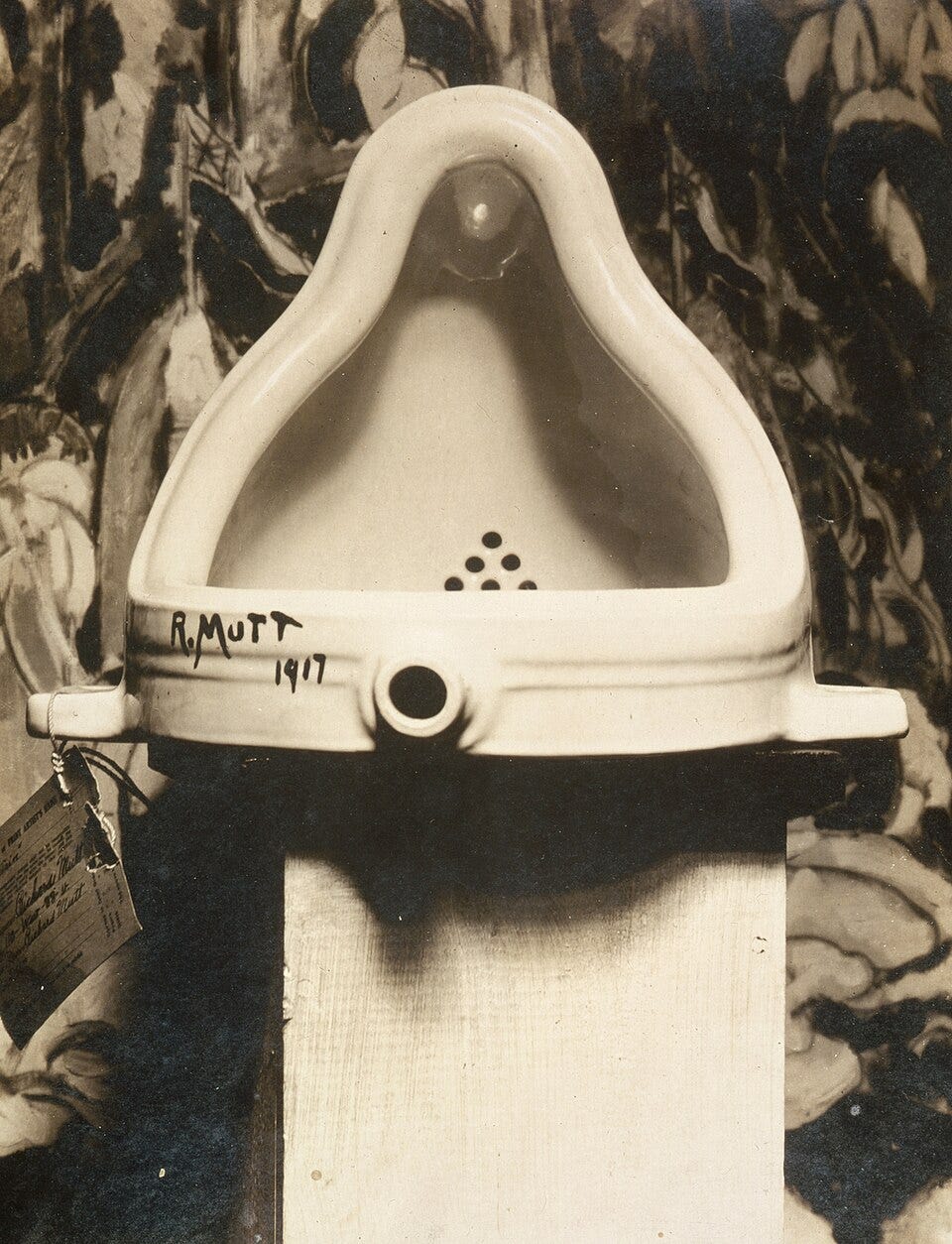
To create this work, Duchamp took a mass-manufactured urinal, flipped it on its side and submitted it as a sculpture to the prestigious Society of Independent Artists exhibition in New York in 1917. In the photograph above, taken by Alfred Stieglitz, you can even see the original entry tag hanging from the bottom left.
Despite the exhibition’s policy—that any artist could pay the $6 entry fee to exhibit—Fountain was famously rejected and deemed too indecent to be shown. It was hidden from view during the show, tucked behind a partition or perhaps never even brought inside, depending on which version of events you believe.
Ironically, the work and the controversy around it helped to propel Duchamp to international artistic fame. While this type of artwork doesn’t seem so strange to audiences now, Duchamp’s ideation of displacing something already existing in the world and calling it art, was scandalous for the time, and the concept cemented his legacy as one of the most important disruptors in the history of art.
Over 100 years after the creation of Fountain, the Museum of Modern Art in New York just opened a retrospective of around 300 Duchamp works. Several other events are also swirling the city, including a book launch for Duchamp Takes New York by John Strausbaugh, and it was announced earlier today that Gagosian will mount its own Duchamp show, opening April 25.
It’s often said that Duchamp’s readymade laid the groundwork for conceptual art, but its influence hasn’t stopped there. We see it echo through contemporary artistic practice and just as clearly in the rhythms of everyday culture, from meme-making to Instagram.
To really grasp how far this idea has travelled, it helps to go back a bit.